
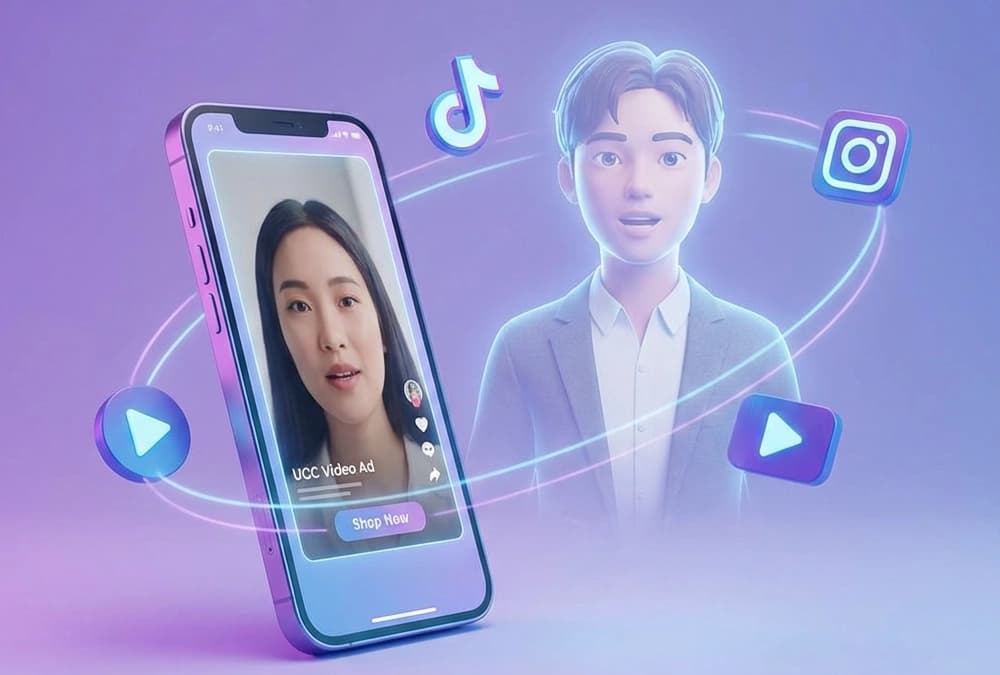
TL;DR: What You Need to Know About AI UGC
- AI UGC uses synthetic avatars, AI voices, and automated scripts to create authentic-looking marketing videos without hiring creators
- Brands save 90% on content costs ($5-20/video vs $150-500 with traditional creators)
- Production time drops from days to minutes - create 100+ video variations in hours
- AI UGC performs on par with traditional UGC in ad campaigns when properly optimized
- Best for: e-commerce brands, agencies, dropshippers, and anyone scaling video ad production
What is AI UGC?
AI UGC (Artificial Intelligence User-Generated Content) is marketing content created using AI technologies to produce videos that look and feel like authentic creator content - without hiring actual creators.
Instead of paying influencers or UGC creators $150-500 per video, brands now use AI avatars, synthetic voices, and AI-written scripts to generate unlimited variations of testimonial-style, review, or promotional videos.
The term "UGC" traditionally refers to content created by real users or customers. However, AI generated UGC mimics the format, style, and authenticity of traditional UGC while being entirely produced by artificial intelligence. The result looks like a real person sharing their genuine experience with a product - but it's powered by sophisticated AI technology.
The Evolution of AI UGC: 2023 to 2026
The AI UGC landscape has transformed dramatically in just three years:
2023: Early Experiments The first AI video tools emerged with obvious limitations. Avatars looked robotic, lip-sync was clearly off, and voices sounded mechanical. Only early adopters tested these tools, and most results were unusable for serious advertising.
2024: The Breakthrough Year Major improvements in avatar realism and voice synthesis made AI generated UGC viable for real campaigns. Companies like HeyGen and Synthesia improved dramatically. The first successful AI UGC ad campaigns emerged, proving the concept could work at scale.
2025: Mainstream Adoption AI UGC tools became accessible to small businesses. Pricing dropped significantly. Platform policies on TikTok and Meta clarified rules around AI-generated content. The stigma around using artificial intelligence UGC began to fade as results spoke for themselves.
2026: The New Standard Today, AI UGC is a standard tool in the modern marketer's toolkit. Avatar quality is nearly indistinguishable from real footage in many cases. Voice synthesis captures emotion and nuance. Smart brands use UGC AI alongside traditional creator content as part of a comprehensive content strategy.
The Simple Breakdown
| Component | What It Does |
|---|---|
| AI Avatar | A realistic digital human that appears on camera |
| AI Voice | Text-to-speech that sounds natural and emotional |
| AI Script | Copy generated or enhanced by language models |
| The Result | A complete video ad ready for TikTok, Instagram, or Facebook |
Why It's Called "UGC" Even Though It's AI
The "UGC" label comes from the content format, not the creator. Traditional UGC has a specific aesthetic: casual filming, authentic delivery, relatable presenters, and a non-corporate feel. AI UGC replicates this format precisely.
When viewers scroll through TikTok or Instagram, they're looking for content that feels real and relatable. AI generated UGC delivers that experience while giving brands complete control over the message, timing, and scale of production.
AI UGC vs Traditional UGC
| Factor | Traditional UGC | AI UGC |
|---|---|---|
| Cost per video | $150-500 | $5-20 |
| Production time | 3-7 days | 5-30 minutes |
| Revisions | Additional fees | Unlimited, instant |
| Scalability | Limited by creator availability | Unlimited |
| Consistency | Varies by creator | 100% controlled |
| Authenticity feel | High | Good to excellent |
| Best for | Hero content, brand campaigns | Testing, scaling, variations |
Why Brands Are Switching to AI UGC in 2026
The AI UGC market has exploded. Here's what's driving adoption:
Market Reality
- 78% of e-commerce brands now use some form of AI in their content creation pipeline (up from 45% in 2024)
- The AI video generation market reached $1.8B in 2025 and is projected to hit $3.2B by 2027
- TikTok and Meta have both updated policies to allow AI-generated content with proper disclosure
- Average CAC (Customer Acquisition Cost) for brands using AI UGC is 23% lower than those relying solely on traditional content
- 67% of consumers can't distinguish high-quality AI UGC from traditional creator content
The Economics Are Undeniable
Consider a typical e-commerce brand running paid social ads:
Without AI UGC:
- 20 new ad creatives per month
- Average cost: $250 per video
- Monthly content spend: $5,000
- Annual content budget: $60,000
With AI UGC:
- 100+ new ad creatives per month
- Average cost: $15 per video
- Monthly content spend: $1,500
- Annual content budget: $18,000
That's $42,000 in annual savings while producing 5x more content.
Who's Using AI UGC Successfully
E-commerce Brands
A mid-size skincare brand switched from traditional UGC to an AI UGC hybrid approach in late 2025. Results after 6 months:
- Content production increased from 15 to 80 videos per month
- Cost per acquisition dropped 31%
- Time from concept to live ad reduced from 2 weeks to 48 hours
- ROAS improved by 18% due to faster creative testing
Performance Marketing Agencies
Agencies managing multiple clients face constant pressure to produce fresh creative. One digital agency reported:
- Reduced creative production costs by 65%
- Increased client deliverables by 3x
- Improved profit margins on retainer accounts
- Faster response to client requests and market trends
Dropshippers and DTC Brands
For businesses testing new products, AI UGC eliminates a major barrier. Instead of investing $500+ in creator content for an unproven product, brands can test with $50 worth of AI UGC first. If the product shows promise, they scale with more AI variations or invest in traditional creator content.
SaaS Companies
Software companies use AI UGC for:
- Product demos and walkthroughs
- Customer testimonial-style content
- Feature announcement videos
- Onboarding content at scale
Benefits of AI UGC for Brands
90% Cost Reduction
The math is simple:
- Traditional UGC creator: $150-500 per video
- AI UGC with UGC Lab: $5-20 per video
For a brand running 50 new creatives per month:
- Traditional: $7,500-25,000/month
- AI UGC: $250-1,000/month
Annual savings: $87,000-288,000
No talent fees. No reshoots. No usage rights negotiations. No scheduling conflicts. No waiting for creator availability.
The cost advantage compounds when you factor in:
- Unlimited revisions at no extra cost
- No additional fees for extended usage rights
- No travel or shipping costs for products
- No management overhead for creator relationships
10x Faster Production
| Task | Traditional | AI UGC |
|---|---|---|
| Brief creator | 1-2 days | - |
| Creator films | 2-3 days | - |
| Receive content | 1-2 days | - |
| Request revisions | 2-5 days | - |
| Generate video | - | 5-30 min |
| Make variations | - | Instant |
| Total time | 7-14 days | Under 1 hour |
When a trend hits TikTok, you can have content live in hours, not weeks.
Speed matters for:
- Trend response: Jump on viral moments before they fade
- Seasonal campaigns: Ramp up holiday content quickly
- Product launches: Create comprehensive video libraries instantly
- A/B testing: Test dozens of variations simultaneously
- Market expansion: Launch in new regions with localized content immediately
Total Brand Control
With AI UGC, you control every aspect of your content:
- Script control: Change the script anytime - no creator approval needed
- Instant variations: Create 50 versions with different hooks in minutes
- Comprehensive testing: A/B test avatars, voices, scripts, CTAs, and formats
- Global reach: Multilingual content without hiring international creators
- Zero drama: No risk of creator controversies, contract disputes, or content ownership issues
- Consistent quality: Every video meets your standards, every time
- Always available: Your AI avatar never gets sick, goes on vacation, or misses deadlines
Best AI UGC Tools in 2026
Choosing the right AI UGC tool depends on your specific needs, budget, and technical requirements. Here's how the leading platforms compare:
Quick Comparison
| Tool | Best For | Starting Price | Avatar Quality | Voice Quality | Ease of Use |
|---|---|---|---|---|---|
| UGC Lab | All-in-one UGC production | $29/mo | Excellent | Excellent | Very Easy |
| Arcads | E-commerce focus | $100/mo | Very Good | Good | Easy |
| HeyGen | Corporate/Enterprise | $89/mo | Excellent | Very Good | Moderate |
| Synthesia | Training videos | $29/mo | Good | Good | Easy |
| Creatify | Quick ads | $39/mo | Good | Good | Very Easy |
UGC Lab: Best Overall for AI UGC
Why it leads:
UGC Lab was built specifically for creating UGC-style advertising content. Unlike tools designed for corporate videos or training content, every feature focuses on what makes ads convert.
Key strengths:
- Purpose-built for UGC ads, not repurposed corporate video tech
- All-in-one workflow: script generation, avatar selection, voice synthesis, and video export
- Performance-optimized templates based on proven ad frameworks
- Hook formulas and script structures that actually convert
- Affordable pricing that scales with your needs
Best for: E-commerce brands, agencies, and anyone serious about scaling AI UGC production.
Arcads: Best for E-commerce
Arcads focuses heavily on e-commerce use cases with features tailored for product-focused content.
Strengths: Strong product showcase features, e-commerce integrations Limitations: Higher price point, less flexibility for non-e-commerce content
HeyGen: Best for Enterprise
HeyGen offers enterprise-grade features and exceptional avatar quality, but at premium pricing.
Strengths: Highest avatar quality, enterprise security features Limitations: Expensive for small teams, overkill for simple UGC ads
Synthesia: Best for Training Content
Synthesia pioneered AI video but focuses more on corporate and training applications.
Strengths: Established platform, good for internal communications Limitations: Less optimized for social media advertising formats
Creatify: Best for Quick Turnaround
Creatify emphasizes speed and simplicity over advanced customization.
Strengths: Very fast generation, simple interface Limitations: Fewer customization options, less control over final output
How to Choose the Right Tool
Consider these factors:
- Primary use case: Social ads vs corporate videos vs training content
- Volume needs: Occasional videos vs high-volume production
- Budget: Monthly spend you can allocate to AI UGC tools
- Team skills: Technical capability of your content team
- Integration needs: Connection with existing marketing tools
How to Create AI UGC (5 Simple Steps)
Creating effective AI UGC involves a strategic approach combining the right tools with proven content frameworks. Here's the complete process:
Step 1: Write Your Script (or Let AI Help)
The script is everything. A great script with an average avatar outperforms a perfect avatar with a weak script every time.
Hook formula that works:
"I was skeptical about [product category] until I tried [product]..."
"I've tried everything for [problem] and nothing worked until..."
"Okay, I need to talk about [product] because..."
Script structure for 30-60 second AI UGC:
- Hook (0-3 seconds): Grab attention immediately
- Problem (3-10 seconds): Relate to the viewer's pain point
- Solution (10-25 seconds): Introduce your product as the answer
- Proof (25-40 seconds): Share specific results or benefits
- CTA (40-60 seconds): Tell them exactly what to do next
Script tips:
- Keep it under 60 seconds for TikTok/Reels
- Front-load the hook - first 3 seconds determine if people keep watching
- Write conversationally, not corporate
- Include specific details (numbers, timeframes, results)
- End with a clear call-to-action
Step 2: Choose Your Avatar
Match your avatar to your target audience for maximum relatability:
Demographic alignment:
- Age range that matches your customer base
- Gender appropriate for your product
- Style and appearance that resonates with your audience
Setting matters:
- Casual home background for DTC products
- Professional setting for B2B or premium products
- Lifestyle environment for aspirational brands
Authenticity cues:
- Natural lighting over studio lighting
- Realistic movements and gestures
- Appropriate wardrobe for the context
Pro tip: Test multiple avatars with the same script. Small differences in presenter can significantly impact conversion rates.
Step 3: Select the Right Voice
Voice creates emotional connection and determines whether viewers trust your message:
Voice selection criteria:
- Match energy level to your brand (calm and authoritative vs enthusiastic and energetic)
- Consider accent for market targeting (US, UK, Australian, etc.)
- Ensure clarity - the message must be easy to understand
- Test pacing - some products benefit from faster or slower delivery
Voice optimization:
- Test multiple voices with the same script
- Small changes in voice can impact performance by 20% or more
- Match voice to avatar for consistency
- Consider your target demographic's preferences
Step 4: Generate and Preview
Before exporting, review your AI UGC carefully:
- Watch the full video at least twice
- Check lip-sync accuracy - modern tools are good, but verify
- Ensure pacing feels natural - adjust if it feels rushed or slow
- Verify captions if using them - AI transcription can make errors
- Preview on mobile - most viewers will watch on phones
Quality checklist:
- Avatar movements look natural
- Voice sounds authentic and clear
- Script delivery has appropriate emotion
- Video resolution is high quality
- No glitches or artifacts visible
Step 5: Export and Optimize for Platform
Each platform has different requirements and best practices:
| Platform | Aspect Ratio | Optimal Length | Key Optimization |
|---|---|---|---|
| TikTok | 9:16 | 30-60 seconds | Strong hook, trending sounds |
| Instagram Reels | 9:16 | 30-90 seconds | Visual variety, text overlays |
| Facebook Ads | 9:16 or 1:1 | 15-30 seconds | Clear CTA, benefit-focused |
| YouTube Shorts | 9:16 | 30-60 seconds | Value upfront, engaging thumbnail |
| 1:1 or 16:9 | 30-90 seconds | Professional tone, B2B focus |
Platform-specific tips:
TikTok: Lead with the hook, use trending audio when relevant, keep it feeling native to the platform
Instagram: Add text overlays for silent viewing, use hashtags strategically, consider carousel-style content
Facebook: Front-load benefits, include captions (85% watch without sound), clear CTA
YouTube: Create compelling first frame, optimize title and description, consider longer-form content
AI UGC Use Cases
AI generated UGC works across multiple industries and content types. Here's how different businesses leverage artificial intelligence UGC:
E-commerce Product Videos
E-commerce is the largest use case for AI UGC, and for good reason - product-focused content is perfectly suited for AI generation.
Product reviews:
"I've been using this for 2 weeks and here's what I noticed..."
Create multiple review-style videos highlighting different product benefits. Test various angles: durability, ease of use, value for money, results achieved.
Unboxing style: First impressions and packaging reveals work well with AI avatars. Show excitement about receiving the product, highlight packaging quality, and transition to product demonstration.
Before/after content: Transformation content for beauty, fitness, and home products. AI UGC can narrate the transformation journey while showing results imagery.
Comparison content:
"I tried 5 different [products] and this one won because..."
Position your product against alternatives with honest, benefit-focused comparison content.
Product education: How-to-use videos, tips and tricks, and getting the most from your product. This type of AI generated UGC builds trust and reduces returns.
Social Media Ads
Social platforms are where AI UGC truly shines:
TikTok Spark Ads: Native-feeling content that doesn't scream "advertisement." AI UGC matches the authentic, creator-driven aesthetic that performs best on TikTok.
Instagram Reels Ads: Story-driven content with strong hooks. Use AI UGC for the hook, then transition to product footage.
Facebook/Meta Ads: Testimonial-style videos perform exceptionally well for retargeting. AI UGC lets you create multiple testimonial variations to keep creative fresh.
YouTube Shorts: Quick product highlights, tips, and demonstrations. AI UGC works well for the talking-head portion of Shorts content.
Testimonials and Reviews
AI UGC excels at creating testimonial-style content:
Customer story format:
"I was struggling with [problem] until I found [product]. Now [positive outcome]..."
Results showcase: Specific outcomes and transformations narrated by AI avatars with supporting visuals.
Expert endorsement style: Authority-building content where AI avatars present as knowledgeable sources.
Social proof compilation: Multiple "customers" sharing brief positive experiences, creating the impression of widespread satisfaction.
B2B and SaaS Applications
AI UGC isn't limited to consumer products:
Product demos: Walkthrough software features with an AI presenter Customer success stories: Testimonial-style content for case studies Feature announcements: Quick videos explaining new capabilities Onboarding content: Welcome sequences and getting-started guides
AI UGC vs Traditional UGC Creators: When to Use Each
Smart brands don't choose between AI UGC and traditional creators - they use both strategically.
Use AI UGC When:
- Testing new products or markets - Validate before investing heavily
- Scaling winning ad concepts - Create 50+ variations of proven scripts
- Creating multilingual content - Instant translation without hiring
- Working with tight budgets - Maximize content output per dollar
- Needing fast turnaround - Respond to trends in hours, not weeks
- Running high-volume A/B tests - Test everything systematically
- Maintaining always-on content - Never run out of fresh creative
Use Traditional Creators When:
- Building long-term brand ambassadors - Real relationships matter
- Creating hero content - Flagship brand campaigns
- Targeting authenticity-sensitive audiences - Some demographics prefer real creators
- Products requiring physical demonstration - Hands-on interaction needed
- Influencer marketing strategies - Leveraging creator audiences
- High-stakes brand moments - Major launches and announcements
The Hybrid Approach (Recommended for 2026)
Most successful brands today use a hybrid strategy:
- Test with AI UGC first - Find winning hooks, scripts, and angles with low-cost AI content
- Scale winners with AI - Create 50+ variations of concepts that prove themselves
- Invest in hero content - Use traditional creators for flagship brand pieces
- Retarget with AI - Personalized follow-up content at scale
- Refresh constantly - Use AI UGC to keep creative libraries fresh
This approach maximizes ROI while maintaining authentic brand presence where it matters most.
Legal Considerations and Best Practices (2026 Update)
Navigating the legal landscape of AI-generated content requires awareness of current regulations and ethical considerations.
Disclosure Requirements
FTC Guidelines (United States):
- AI-generated content in testimonials must be disclosed
- "AI-generated" or "Created with AI" labels recommended
- Cannot make false claims about AI avatars being real customers
- Endorsement guidelines apply to AI-generated testimonials
- Material connections must still be disclosed
Platform Policies (Current as of 2026):
TikTok:
- Requires AI label for realistic synthetic media
- Must use AI content labels in Creator tools
- Prohibited from using AI to deceive about identity
Meta (Facebook/Instagram):
- AI-generated content must be labeled in Ads Manager
- Disclosure required for photorealistic AI content
- Transparency requirements for political/social content
YouTube:
- Disclosure required for realistic altered or synthetic content
- Labels available in upload process
- Stricter rules for content involving real people
Best Practices for Compliance
- Label appropriately - Add "AI-generated" or "Created with AI" in video description or as an overlay
- Don't fake reviews - AI testimonials should represent real product benefits, not fabricated customer experiences
- Keep records - Document that content is AI-generated for compliance purposes
- Stay updated - Regulations are evolving rapidly; review policies quarterly
- When in doubt, disclose - Transparency builds trust and protects legally
What's Allowed
- Using AI avatars to deliver scripted marketing messages
- Creating product demonstrations with AI presenters
- Generating variations of approved marketing copy
- Multilingual versions of existing approved content
- Educational and informational content with AI presenters
What to Avoid
- Claiming AI avatars are real customers without disclosure
- Using AI to create fake celebrity endorsements
- Making misleading claims about product performance
- Creating deepfakes of real people without consent
- Using AI UGC to deceive about material facts
Getting Started with AI UGC
Ready to transform your content production? Here's your action plan:
This Week
- Audit your current content costs - Calculate exactly what you're spending per video including creator fees, revisions, and management time
- Identify your highest-performing ad - This becomes your first AI UGC test script
- Sign up for UGC Lab - Start with a free trial to test the platform and explore capabilities
- Create your first AI UGC video - Use your proven script with an AI avatar and compare the result
This Month
- Create 10 variations of your best-performing concept with different hooks and avatars
- Test different avatars with the same script to find what resonates with your audience
- Launch A/B tests on your primary ad platform comparing AI UGC to existing content
- Measure and compare performance data between AI and traditional content
- Identify opportunities where AI UGC can supplement or replace traditional production
This Quarter
- Develop a hybrid strategy - Define when to use AI UGC vs traditional creators
- Build template libraries - Create reusable script frameworks for common content types
- Scale production - Increase AI UGC output based on performance data
- Optimize workflows - Integrate AI UGC into your regular content calendar
- Train your team - Ensure everyone understands how to create effective AI UGC
The Goal
Replace repetitive, expensive creator work with AI while investing saved budget into strategic brand content that truly requires the human touch. The brands winning in 2026 aren't choosing between AI and human - they're using each for what it does best.